
How to Read a Land Survey: A Clear Guide for Homeowners & Property Owners
Hannah Taylor
January 29, 2026
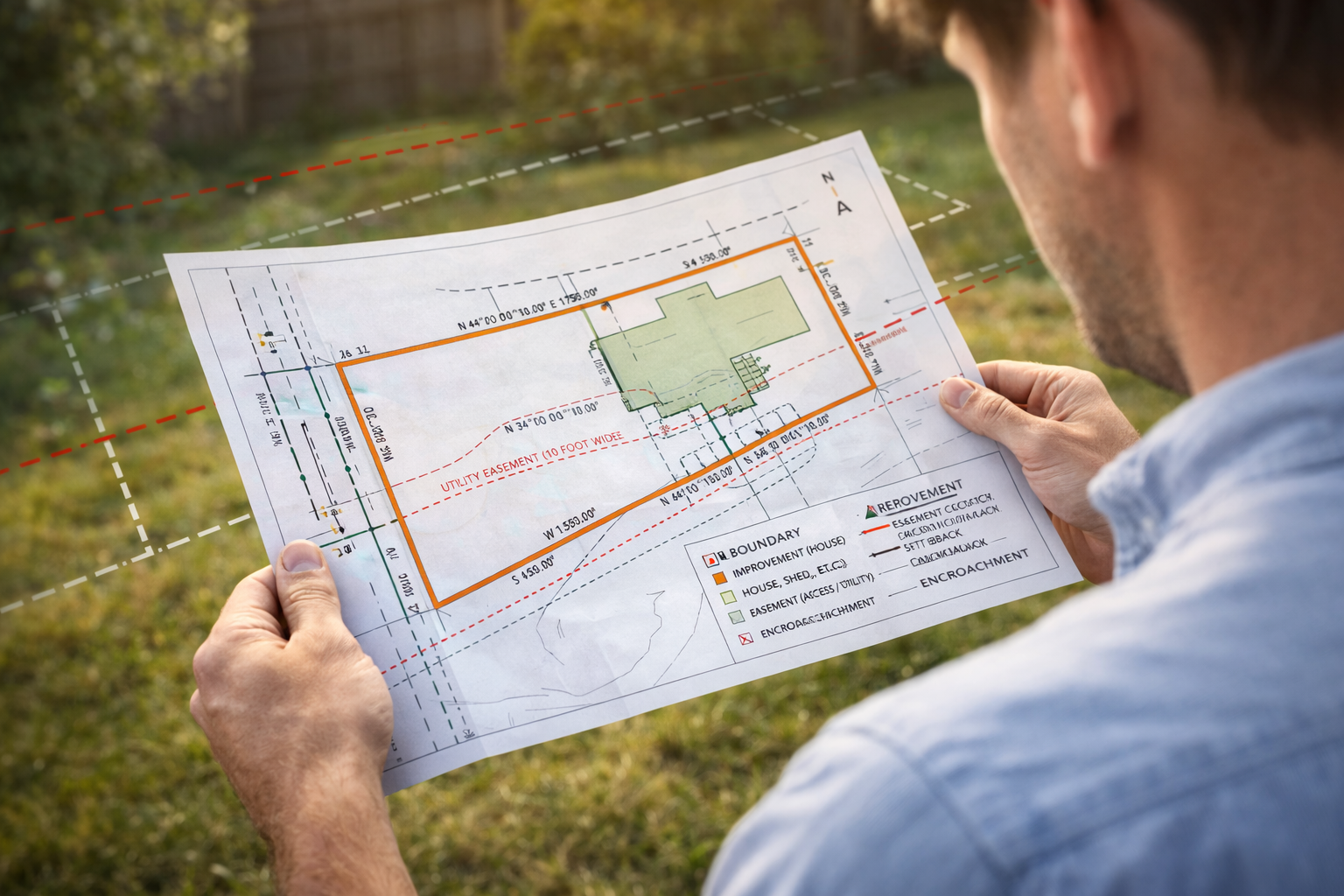
Land surveys contain lines, symbols,and terminology that may feel overwhelming. But understanding your survey iskey to knowing exactly what you own, where your boundaries are, and what rightsor limitations exist on your property.
This guide breaks down the majorelements you will typically see on a survey and how to interpret themconfidently.
Key Elements Found on a Survey
Property Boundaries
The boundary lines define theperimeter of your lot. They are shown with bearings (direction) and distances(length).
On our surveys, boundaries appear as thick orange lines.
Improvements
These represent the existing permanentphysical features located on the property. Examples include houses, sheds,garages, fences, pavements, and other visible structures. We do not showlandscaping unless requested.
We show these features using green lines.
Easements
An easement grants access or usagerights to another party,commonly utility companies or neighboring properties.
Easements on our surveys use dashed red lines.
Encroachments
These are features that cross aproperty line such as a structure extending onto an adjacent parcel.
We list encroachments in our “Points of Interest” section.
Setbacks(When Applicable)
Setbacks indicate areas wherecertain features cannot built due tolocal regulations or land-use rules. Even though we do not determinecompliance, we can show the documented setback lines that apply to a parcel.
In our surveys, setbacks appear as gray dashed lines.
Lega lDescription
A written description that definesthe property using either, fracational, metes & bounds or lot/blockinformation from a recorded plat.
North Arrow & Scale
These indicate direction and show how measured distances on the survey relate to actual distances on the ground.
Legend& Notes
These clarify symbols,abbreviations, and observations made during data collection.
WhyUnderstanding Your Survey Matters
Reading your survey correctlyensures that you:
- Know exactly where your property begins and ends
- Understand easements or areas with access rights
- Can identify encroachments or physical features that may require attention
- Have accurate information for title insurance, closings, or property records
- Avoid misunderstandings with neighboring properties
While surveys are not created todetermine compliance or authorize future work, they provide the factual information about the property necessary for decision-making.
We’re Here to Help You Understand Your Survey
A land survey is more than a drawing, it is a legal representation of yourproperty. At First Choice Surveying, we are available to help clients interprettheir surveys clearly and confidently. We also work with title companies,attorneys, and other professionals who rely on accurate survey information.
If you have questions about readingyour survey or need a new one completed, contact us today. Our goal isto provide both accuracy and clarity, so you always know exactly what is onyour property.
Related Articles
Lorem ipsum dolor sit amet, consectetur adipiscing elit.

A Career in Surveying

Why Licensing Matters